Let me be honest with you, when I first told people I was going to Oman alone, the reactions were… mixed. A few eyebrows shot up. Someone suggested I “bring a friend.” Another person Googled it mid-conversation with a worried expression.
I went anyway. And it became one of the most transformative solo trips of my life.
Oman doesn’t get nearly enough credit. While the world fixates on Dubai’s glitter or debates safety in other Gulf nations, this quiet, dignified country on the southeastern tip of the Arabian Peninsula quietly hosts thousands of solo female travelers every year, many of whom leave wondering why they didn’t come sooner.
But “safe” is never a simple yes or no when it comes to travel, especially for women. So instead of a vague reassurance, this guide gives you the real picture: what works, what to watch for, where you’ll feel completely at ease, and the handful of things worth knowing before you land in Muscat.
Quick Overview: Oman at a Glance
|
Category |
Details |
|
Capital |
Muscat |
|
Currency |
Omani Rial (OMR) — 1 OMR ≈ $2.60 USD |
|
Official Language |
Arabic (English is widely spoken) |
|
Religion |
Islam (Ibadi sect) |
|
Safety Rating |
Generally, Very Safe for Solo Female Travelers |
|
Visa |
E-visa available for most nationalities |
|
Best Time to Visit |
October to March |
|
Primary Risk Areas |
Remote desert roads (navigation), extreme summer heat |
Why Oman Stands Apart in the Middle East
Oman operates on its own cultural frequency. Governed by the principles of Ibadi Islam, a moderate, non-proselytizing branch, the country has historically been more socially relaxed than its neighbors. Women here have long worked alongside men in public roles, and foreign visitors, particularly solo female travelers, are treated with genuine hospitality rather than suspicion or harassment.
The Omani people have a phrase, “Al dayf habib Allah,” which roughly translates to “The guest is beloved of God.” That’s not just poetry. You feel it in the way a shopkeeper offers you tea without any expectation of purchase, in the way a local family waves you over to share their picnic at Wadi Shab, in the unexpected kindness of strangers who notice you’re lost before you even realize it yourself.
Oman also ranked consistently well in regional safety indexes. Violent crime against tourists is exceptionally rare, and solo female travelers who’ve visited frequently rank it among the safest countries they’ve explored in the broader Middle East and North Africa region.
Top Attractions Worth Building Your Trip Around
1. Muscat — The Capital That Rewards Slow Exploration
Muscat is rarely just a stopover. The Sultan Qaboos Grand Mosque is genuinely breathtaking — one of the world’s great religious buildings, and one that actively welcomes non-Muslim visitors (outside prayer times, with modest dress). The Mutrah Souq is labyrinthine and fragrant, full of frankincense, silver jewelry, and spice merchants who’ve been trading for centuries.
Solo female travelers consistently feel comfortable in Muscat. It’s busy, well-lit, and has enough tourism infrastructure that you’re never far from support if needed.
2. Nizwa — Fort Country and the Soul of the Interior
About two hours southwest of Muscat, Nizwa feels like stepping into a different era. The circular fort dates to the 17th century and offers sweeping views of the surrounding oasis and Hajar Mountains. The Friday goat market is something genuinely unlike anything else on earth.
Dress modestly here — not because you’ll face pressure, but out of respect for a community where traditional life continues largely unchanged.
3. Wadi Shab — The Hike You’ll Talk About for Years
Wadis (riverbeds carved through canyon walls) are Oman’s secret weapon. Wadi Shab requires a short boat crossing, a moderate hike, and a swim through a cave to reach a hidden waterfall. It’s popular with foreign visitors, so you’ll rarely be alone on the trail — which is reassuring for solo travelers.
4. Wahiba Sands (Sharqiyah Sands)
The desert camp experience in Oman’s eastern sands is extraordinary. Most camps cater to tourists and offer safe, organized dune bashing, camel rides, and sunset watching. Booking through a reputable operator means the logistics are handled, ideal for solo travelers who want the experience without navigating remote terrain alone.
5. Salalah — Monsoon Magic in the South
From June to September, Salalah transforms into lush green hills draped in mist, a phenomenon called the Khareef (monsoon season). It’s the one time Omani families flood southward for a holiday. The atmosphere is festive, the waterfalls are dramatic, and the frankincense heritage sites around Dhofar are genuinely fascinating.
Best Time to Visit Oman as a Solo Female Traveler
October to March is the sweet spot. Temperatures in Muscat and central Oman hover between 20–30°C (68–86°F), making hiking, driving, and exploring comfortable.
April to May starts warming up, but it is still manageable if you avoid midday outdoor activity.
June to September is brutal in most of the country (40°C+ / 104°F+). The exception is Salalah, which is actually green and cool during this period.
How to Get to Oman
By Air: Muscat International Airport (MCT) connects to most major global hubs. Airlines including Oman Air, Emirates, Qatar Airways, British Airways, and Lufthansa serve the route. Budget carriers like IndiGo and Air Arabia also fly in from South Asia and the wider Gulf.
By Land: Road crossings from the UAE are straightforward. The Al Ain–Buraimi crossing is the most commonly used. Border crossings are generally efficient.
By Sea: Ferry services operate between Muscat and Khasab (for the Musandam exclave), and seasonal connections exist to Iran and India.
Getting Around: Transportation for Solo Female Travelers
Rental Car
Renting a car gives you maximum freedom and is the most practical way to explore beyond Muscat. Roads are excellent. Signage is in Arabic and English. A standard sedan handles most tourist routes; a 4WD is essential for wadis and desert off-roading.
Tip: Download offline Google Maps before heading into Wadi Country. Connectivity drops in gorges.
Taxis & Ride-Hailing
In Muscat, Careem (the regional Uber equivalent) is reliable, affordable, and lets you track your journey. This is genuinely one of the safest ways to move around the city as a solo woman; you have a digital record of the trip, driver details, and can share your route.
Traditional orange taxis still operate but negotiate fares upfront.
Intercity Buses
ONTC (Oman National Transport Company) buses connect major cities. They’re affordable and perfectly safe, though schedules can be infrequent on some routes.
Organized Tours
For remote areas, Wahiba Sands, Musandam, and the Empty Quarter, guided tours offer the easiest and safest experience for solo travelers. Many Muscat-based operators cater specifically to international visitors.
Accommodation Options
|
Type |
Best For |
Price Range (USD/night) |
|
Luxury Hotels (Muscat) |
Comfort & Security |
$150–$400+ |
|
Mid-Range Hotels |
Most Solo Travelers |
$50–$150 |
|
Guesthouses/Homestays |
Budget + Local Experience |
$20–$50 |
|
Desert Camps |
Unique Experience |
$80–$200 |
|
Hostels |
Budget Backpackers |
$15–$35 |
Most budget guesthouses in Oman are family-run and perfectly safe for solo female travelers. Book in advance during peak season (November–February).
Food and Local Cuisine: What to Eat in Oman
Omani cuisine is aromatic, generous, and underrated. Don’t leave without trying:
- Shuwa — slow-cooked lamb wrapped in banana leaves, buried underground for up to 48 hours. Found at feasts and specialty restaurants.
- Mashuai — roasted kingfish with rice and lemon sauce, a coastal classic.
- Harees — slow-cooked wheat and meat porridge, deceptively comforting.
- Omani Halwa — a dense, syrup-sweet confection flavored with saffron and rose water. Served with coffee in every traditional setting.
- Khubz Ragag — paper-thin flatbread often served with eggs and honey for breakfast.
Restaurants in Muscat run the full spectrum from street food to fine dining. As a solo female diner, you’ll have zero issues eating alone. The culture is welcoming, and the restaurant staff is used to foreign visitors.
Travel Costs and Budget Tips
Sample Daily Budget
|
Budget Level |
Estimated Daily Cost (USD) |
|
Backpacker |
$35–$60 |
|
Mid-Range Traveler |
$80–$150 |
|
Comfort Traveler |
$150–$300+ |
Money-Saving Tips:
- Eat at local biryani joints and bakeries rather than hotel restaurants — meals from $2–5.
- Use Careem over tourist taxis for shorter rides.
- Visit wadis independently rather than booking tours (bring a local offline map).
- Travel in shoulder season (October or March) when accommodation prices dip.
- Frankincense and silver jewelry are negotiable in souqs.
Is Oman Safe for Solo Female Travelers? The Honest Truth
Short answer: Yes — Oman is one of the safest countries in the Middle East for solo female travel.
Here’s the nuanced reality:
What works strongly in your favor:
- Violent crime against tourists is extremely rare
- Harassment, catcalling, following, and unwanted contact are far less common than in many European or Asian tourist hotspots
- Police presence is professional and generally trustworthy
- Locals genuinely respect personal space
- English is widely understood in tourist areas
What you should still be aware of:
- Oman is a Muslim-majority country with conservative social norms in rural areas
- Dress codes, while not legally enforced for tourists the way they are in Saudi Arabia, are genuinely appreciated outside resort areas
- Solo late-night wandering in unfamiliar areas should follow the same caution you’d apply anywhere
- Remote desert driving carries real logistical risks (navigation, heat, vehicle breakdowns). Always tell someone your route
Practical Dress Guidance:
- In Muscat malls and restaurants, loose clothing covering shoulders and knees is comfortable and appropriate
- At beaches: swimwear is fine at resort beaches; cover up when walking to and from
- In mosques or interior towns: full modest dress (scarf for hair recommended)
- You won’t be required to wear an abaya
Safety Tips Specifically for Solo Female Travelers in Oman
- Share your itinerary with someone back home — especially for wadi hikes and desert drives.
- Use Careem rather than unmarked taxis at night.
- Book accommodation ahead in smaller towns — options are limited, and walking unfamiliar streets at midnight looking for a guesthouse isn’t ideal anywhere.
- Carry a local SIM card — Ooredoo and Omantel both offer tourist SIMs with reasonable data packages at the airport.
- Dress modestly outside resort zones — not out of fear but out of respect, and it genuinely reduces the already-rare chance of unwanted attention.
- Learn two phrases — “Shukran” (thank you) and “La shukran” (no thank you). The latter, delivered calmly and confidently, is universally understood.
- Avoid driving into wadis in flood season. Flash floods kill people every year. Check weather forecasts.
- Trust your instincts — the same gut radar that serves you at home works in Oman too.
Sample 7-Day Solo Itinerary
Day 1–2: Muscat Arrive, acclimatize, explore the Sultan Qaboos Grand Mosque, Mutrah Souq, and the stunning Royal Opera House. Eat grilled fish at a local seafood restaurant.
Day 3: Day Trip to Wadi Bani Khalid Turquoise pools in a stunning canyon, a 2-hour drive from Muscat. Easy to do solo by rental car.
Day 4: Nizwa Fort, Souq, and the surrounding village of Al Hamra. Overnight in Nizwa.
Day 5: Jebel Shams Oman’s “Grand Canyon” dramatic views, cool temperatures, short hike to the viewpoint. Return to Nizwa or head south.
Day 6: Wahiba Sands Arrive at a desert camp by afternoon, watch sunset on the dunes, sleep under stars with a roof option available.
Day 7: Back to Muscat via Wadi Shab, the famous hike and swim. Allow 4–5 hours. Then the evening flight or final night in Muscat.
Local Culture and Etiquette Every Visitor Should Know
- Greet with respect — a hand on the heart and “As-salamu alaykum” is always warmly received.
- Never photograph people without asking — this applies especially to women and in traditional settings.
- Public displays of affection are discouraged and can offend.
- Ramadan changes the rhythm of the country: restaurants close during daylight, and eating or drinking publicly is considered disrespectful. The evenings, however, come alive in a beautiful way.
- Friday is the holy day — some attractions have reduced hours or are closed in the morning.
- Bargaining is expected in souqs — but do it with a smile, not aggression.
Hidden Gems Worth Seeking Out
- Wadi Tiwi — less visited than Wadi Shab, equally beautiful, with green villages clinging to cliffside terraces.
- Bimmah Sinkhole — a turquoise pool formed by a geological collapse, just off the coastal highway. Surreal and free to visit.
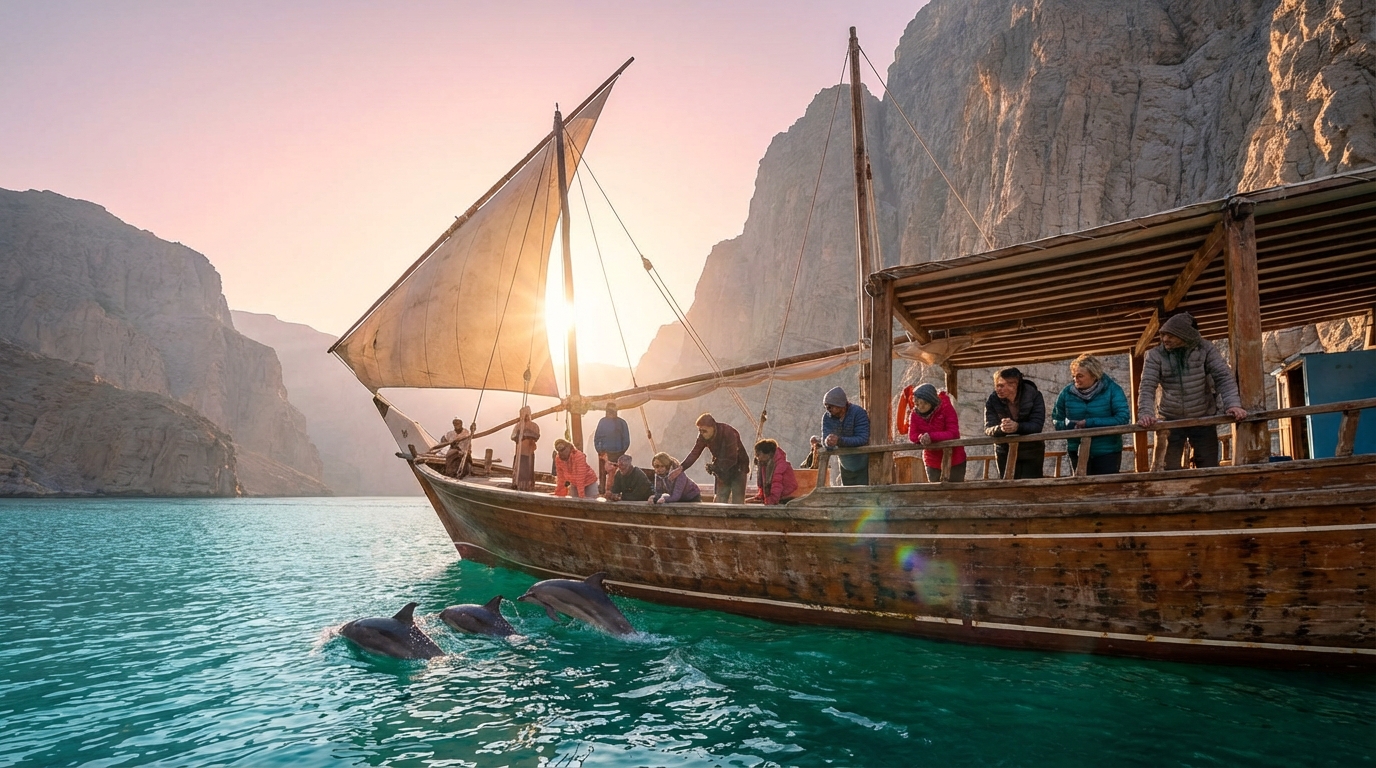
- Khasab and Musandam — Oman’s northern exclave, accessible by ferry or short flight, with dramatic fjords and dolphin-rich waters. Often called “the Norway of Arabia.”
- Al Hoota Cave — a vast limestone cave system near Nizwa, remarkably well-preserved and air-conditioned, a genuine relief in warmer months.
- Mirbat — a tiny coastal town near Salalah with a centuries-old fort, an ancient port history, and almost no tourists.
Frequently Asked Questions
Is Oman safe for solo female travelers in 2026?
Yes. Oman is consistently rated among the safest destinations in the Middle East for solo female travelers. Violent crime against tourists is rare, harassment is uncommon, and the local culture emphasizes respectful hospitality toward guests.
Do I need to wear a hijab in Oman?
No. Foreign women are not required to wear a headscarf or abaya in Oman. Modest dress (covering shoulders and knees) is appropriate in most public spaces and expected inside mosques.
Can I drink alcohol in Oman?
Alcohol is available in licensed hotels, restaurants, and airport shops, but it’s not sold publicly. It’s not something you’ll struggle to find if you want it, but public drinking is not culturally appropriate.
Is solo female travel to rural Oman safe?
Generally yes, though remote areas require more logistical preparation. The cultural reception is welcoming, but practical risks — navigation, heat, vehicle breakdowns make it worth planning carefully and informing others of your route.
What is the best app for getting around Oman solo?
Careem (ride-hailing), Google Maps (with offline download for remote areas), and WhatsApp (for communicating with guesthouses and local contacts) are the three most useful apps.
Conclusion
Oman is the rare destination that lives up to and then quietly exceeds its reputation. For solo female travelers, it offers something increasingly hard to find: a place where you can explore freely, sleep soundly, and walk through an ancient souq without a second thought about personal safety.
It’s not perfect. The summer heat is punishing. Remote wadi driving requires preparation. And like anywhere, it helps to bring your common sense along with your sunscreen.
But the rewards those impossible-blue wadi pools, the golden stillness of Wahiba Sands at dawn, the fragrance of frankincense in a 400-year-old souq more than justify the journey.
Start planning. Book the ticket. Oman is waiting, and it’s going to exceed every expectation you bring to it.
Planning a Daymaniyat Islands trip?
Browse our current snorkelling, diving and private boat trips, or message our team if you have a question about your travel dates.