
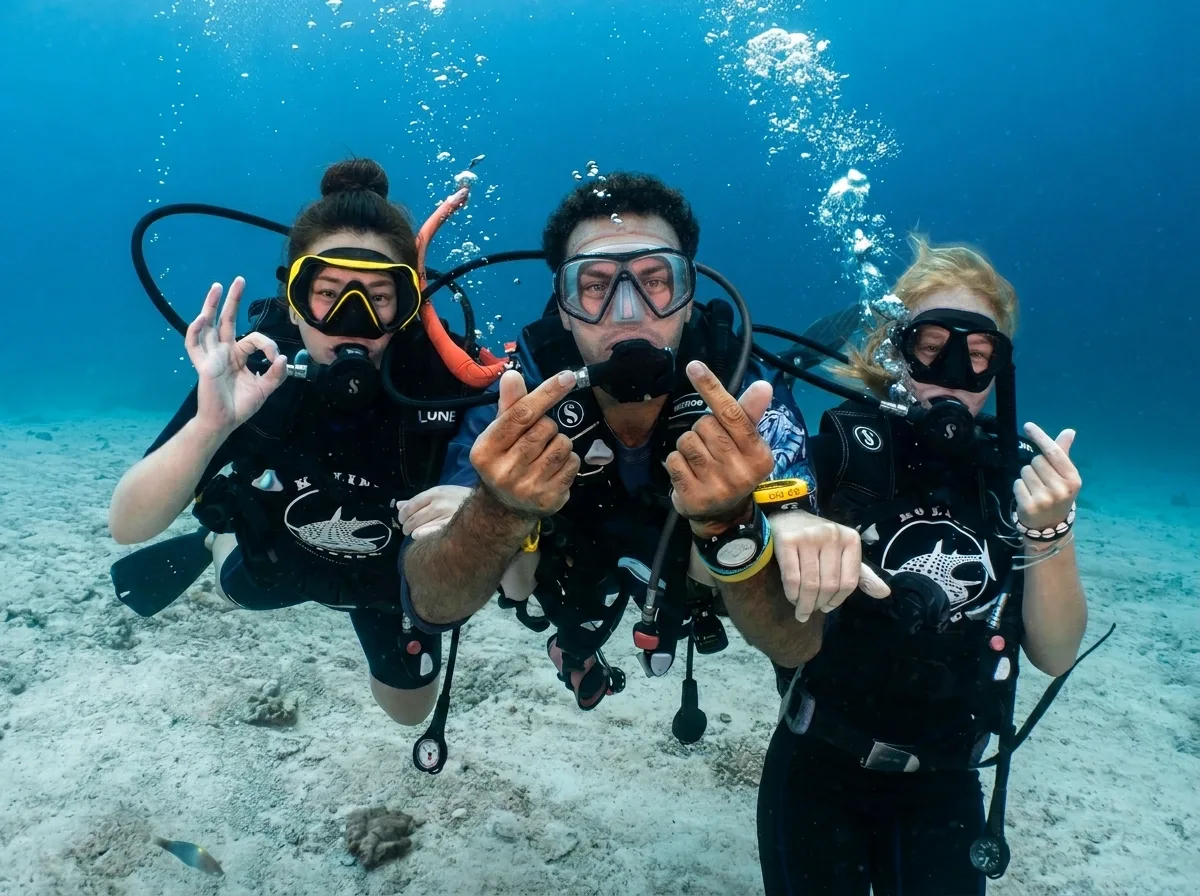
How Do Scuba Divers Communicate Underwater?
Scuba divers use hand signals to communicate underwater when normal speech is not possible. A small set of clear gestures allows divers to check that a buddy is OK, report a problem, change depth, communicate about air supply and respond when something is wrong.
Some of the most important signals for beginner divers include OK, problem, stop, ascend, descend, low on air, out of air and air-pressure checks. Other signals are used for directions, buddy communication, safety stops, marine life and emergencies.
Many basic scuba diving hand signals are widely recognised, but not every signal is identical between instructors, training organisations, regions or dive teams. That is why divers should review the signals they plan to use during the pre-dive briefing rather than assuming everyone will interpret every gesture in exactly the same way.
Essential Scuba Diving Hand Signals Every Beginner Should Know
These are some of the first scuba diving hand signals beginners learn. They allow divers to confirm that everything is OK, report a problem, stop movement and communicate changes in depth without speaking underwater.
Although these basic signals are widely recognised, divers should still review important hand signals with their buddy, instructor or dive guide during the pre-dive briefing.

OK
This means “I am OK” or “Are you OK?”, depending on the context.
Form a circle with the thumb and index finger while keeping the remaining three fingers extended. Divers use this signal frequently to check that their buddy is comfortable and everything is going normally.
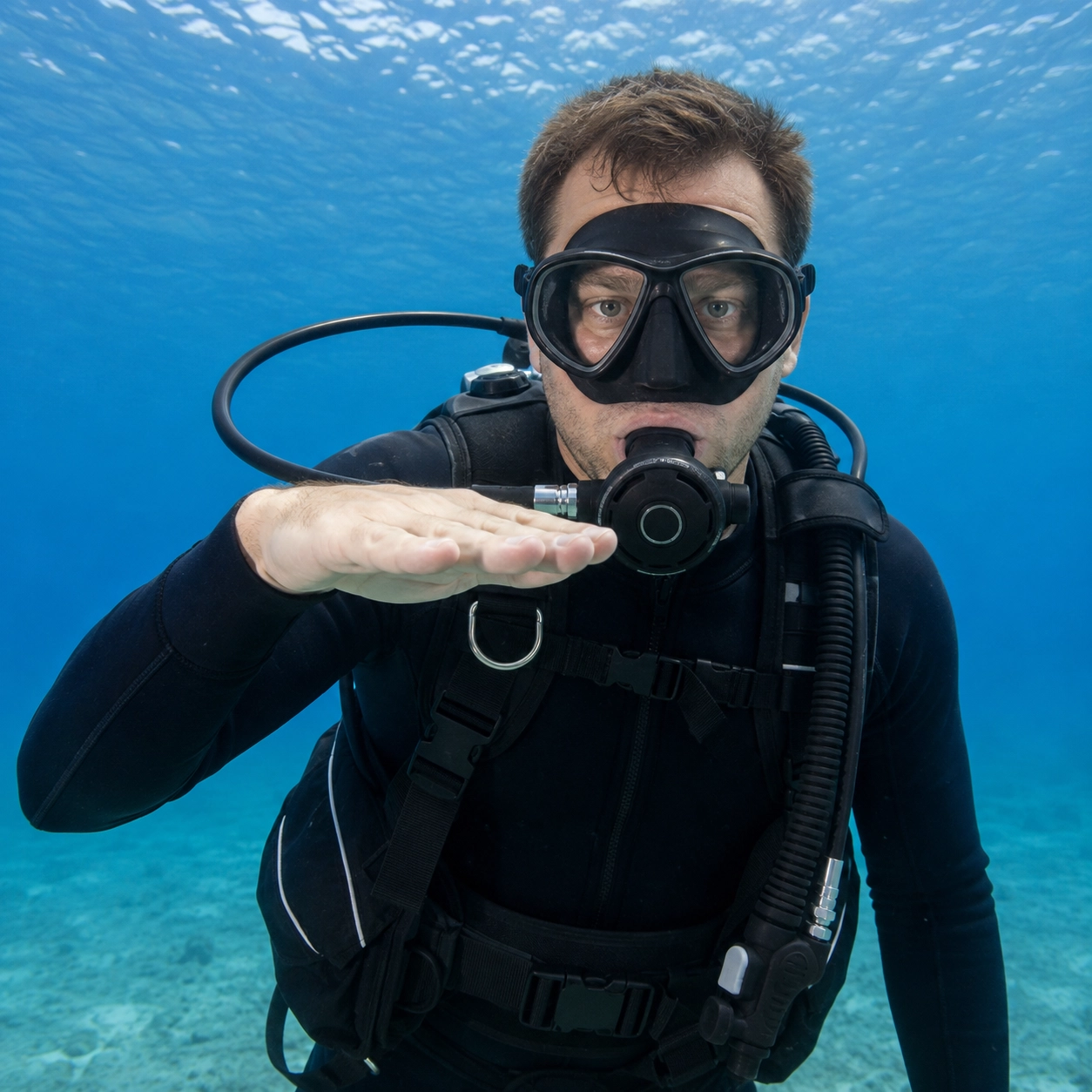
Problem / Something Is Wrong
This means “Something is wrong” or “I have a problem.”
Hold a flat hand roughly horizontal and rock it from side to side. The diver can then point to the source of the problem — for example, an ear, mask or piece of equipment.

Stop
This means “Stop” or “Hold your position.”
An open palm facing the other diver is a clear instruction to stop. It may be used when the dive leader needs everyone’s attention or when something needs to be dealt with before continuing.

Ascend / Go Up
This means “Go up” or “Ascend.”
A thumbs-up underwater does not simply mean “good”. In scuba diving, it communicates upward movement and may be used when beginning an ascent or indicating that the dive should move shallower.

Descend / Go Down
This means “Go down” or “Descend.”
A thumb pointing downward communicates downward movement. It is commonly used when the team is ready to begin descending or when the dive leader wants divers to move deeper.
Air & Gas Pressure Hand Signals for Scuba Diving
Divers need to know how much breathing gas remains, communicate when their supply is getting low and quickly alert a buddy if an air-supply emergency occurs.
These signals are particularly important because they can affect when a dive team turns around, begins an ascent or responds to an emergency. Review them with your buddy or dive professional before entering the water.
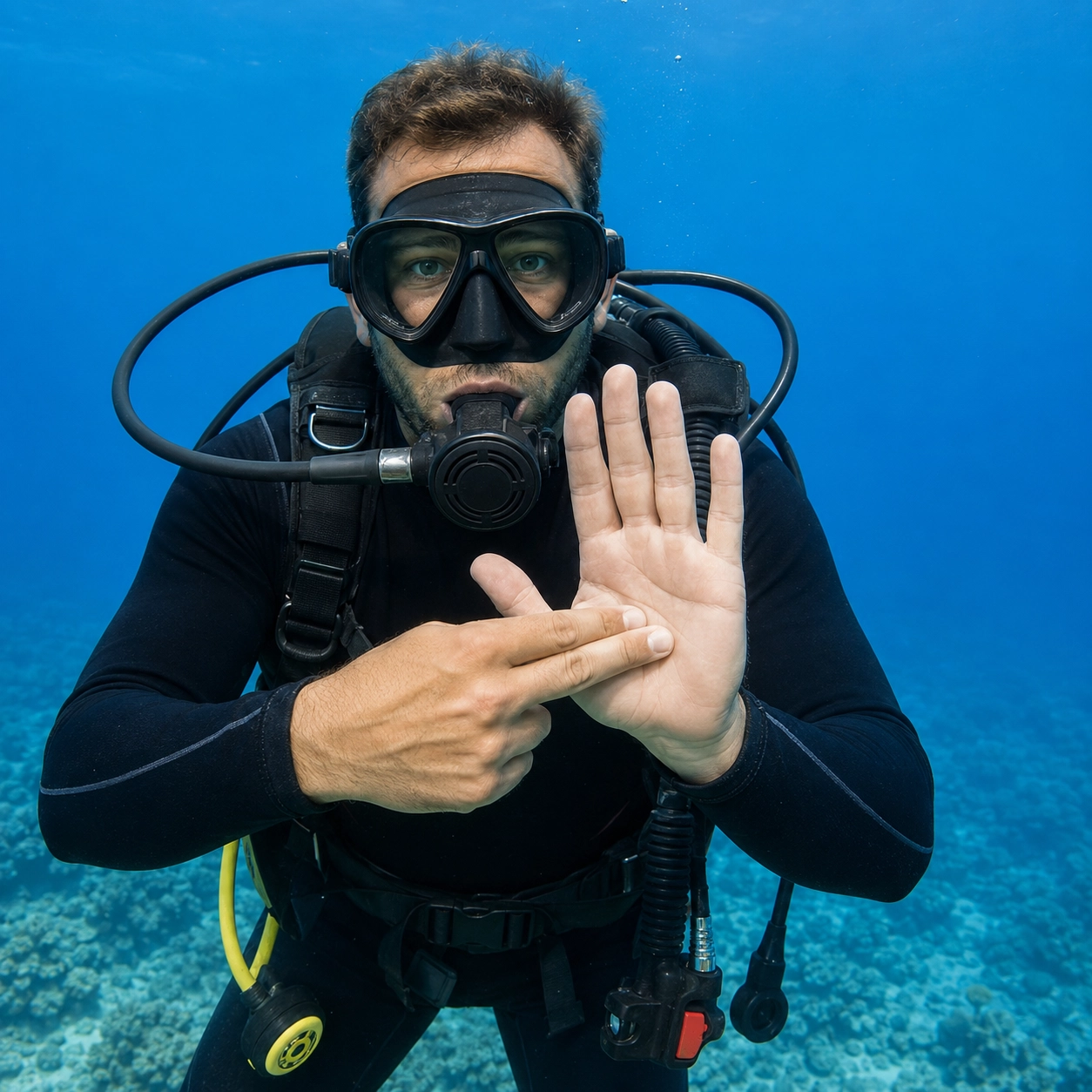
How Much Air Do You Have?
This asks: “What is your remaining cylinder pressure?”
Hold one hand open and use the index and middle fingers of the other hand together to tap the open palm. The other diver then responds with their remaining pressure using the communication method agreed during the dive briefing.

Low on Air
This means: “My breathing gas supply is low.”
Make a closed fist and bring it towards the chest. This tells your buddy or dive guide that your remaining cylinder pressure has reached the low-air point being used for the dive.

Out of Air
This means: “I have no usable breathing gas.”
Move a flat hand across the front of the throat in a cutting motion. This is an emergency signal and requires an immediate response using the air-sharing and emergency procedures taught during scuba training.

Share Air
This means: “I need a breathing-gas source.”
Move an open hand back and forth in front of the mouth or regulator area. The signal communicates the need to share breathing gas or use the buddy’s alternate second stage.
How Do Divers Communicate Remaining Air Pressure?
Asking how much air remains is only half of the conversation. The diver also needs a clear way to report the number shown on the pressure gauge.
Cylinder pressure may be measured in bar or PSI, depending on the equipment and region. Because underwater number and pressure signals can vary, divers should agree before the dive on exactly how remaining pressure will be communicated.
For example, beginner training material commonly discusses 50 bar in metric-based diving and 500 PSI in imperial-based diving as low-air reference points. These figures should not be treated as a universal dive plan: the appropriate turn, ascent and reserve pressures depend on the dive plan, training, conditions and procedures being followed.